Kia ora and welcome...

Hi!

Thanks for stopping by and visiting my blog site.

For those of you visiting from overseas. Welcome to the shores of New Zealand. Kia ora and welcome.

As you can tell I haven't made a posting here since back in October 2009! It's been a while hasn't it? So it's time to start again and I'll do that this week and make it a regular thing with no less than 2 updates a week.

I'll also make them no more than 600 words which should equate to a 3minute read for you. I'm hoping this will give you time to read and return for the next blog while gaining a useful key point while you're here.

Enjoy your visit! And return soon...

Monday, September 7, 2009

Goal Setting Success

Following my last Blog, I thought I'd write you some important stages in coaching a person to formulating a goal and ensure all the parts are present. I'm assuming that you will apply the tips I gave you in the previous blog. I find the popular S.M.A.R.T. formula of goal setting rather tedious and present in this and my previous blog another alternative.
I encourage you to take the 10 goal setting tips I wrote earlier and use this framework to attach those previous important points to and as a result further increase the possibility of you achieving what you want.


GOAL SETTING

Stage 1): KNOW WHAT YOU WANT
I'm going to break this 1st stage down to it's smaller components so you can be more specific in getting this 1st important step right.

You need to KNOW what you want. That is, you are to have the "know-ledge" of what you want. If you do not know what you want, then allow yourself to dream, imagine or consider what it is that you want for your life. There is a real need (in my humble opinion) to know that life without a goal to pursue is a life that is not being self-actualised. I'm not going to fully justify why I am saying that. I will say in brief, that I'm wanting you to know that the pursuit of a goal, whatever it is, brings a greater level of meaning and satisfaction to your life, rather than for you to vegetate and surrender to doing nothing with your life on a regular, long term basis (for some this is a full time occupation).

A personal goal will give you a sense of direction and purpose. A goal-less life, is a life that has less meaning and less purpose. I hope that is enough for you to consider setting yourself a goal. And doing it quickly. Be it a short-term or long-term goal, but a goal all the same. You may want to start with something small and build up to setting larger and more bodacious goals as you grow in confidence in goal achieving.

You need to know what you want. It's important that YOU want it. The first stage that's needed for you, is that what you want, MUST be something that YOU and YOU alone - want! It is not to be something that you want, because he or she (Mum or Dad) wants you to have it as a goal. The focus that I am wanting you to have at this stage is that you are pursuing your goal because YOU want it.

Lastly - Whatever it is that you know you want. You must WANT it. You will achieve it if you want it enough. It's the want that will drive you forward and break through any and all setbacks. When you want it and want it with every cell of your mind and body you will have it.

Too often we say we want something and it is not a WANT it's only a WISH! Do you want it? Does it fill your being with desire to posses it? When you want at this level you will achieve it you will get what you want. The main thing that stops you from having what you want is not the knowing of what you want -it is the lack of wanting. To want it more and more ask yourself the question why? Why do you want it? Why else do you want it and ask this question some 7-12 times and make a list and quickly become embroiled in the 3-5 main reasons why you want it and be conscious of it throughout your day. Increase your initial desire for what you want by being mindful of the WHY that drives you to want to achieve your goal.


Stage 2): TAKE ACTION
Once you know what you want it's time to do something about it. Not just anything but a planned and strategic approach to specific, practical steps that lead you towards what you want. (read that sentence again and again till you get it).

Here are some questions that you will need to answer, so that you take calculated and practical steps in actioning your goal. Some may be more relevant than others.

  • Do you know what you need to be doing to get what you want?

  • Who do you need to speak to?

  • When will you start taking action?

  • When will you achieve it exactly?

  • What do you need so you can achieve your goal?

  • What resources do you need, both internal and external resources?

  • Who needs to support you in your goal achieving journey?

  • What is you 1st, 2nd and 3rd steps?

  • What are you going to do in the short-term?

Apply the answers that you have and put them into an action plan. Be detailed in the writing of your plan. Leaving nothing out. Make it clear and precise. The more precise you are in the action steps that you write into your plan, the higher the likelyhood of you achieving what you want. Spare no detail when making an action plan. This stage will give you confidence and formulate a more complete understanding of the effort required of you.


Stage 3): RISK MANAGEMENT
I want you to now address the possible risks, setbacks or self-sabotage that may occur in taking action while in the pursuit of your goal. Use the following questions to assist you in minimising the likelihood of you failing.


  • What could possibly go wrong for you?

  • What may sabotage your efforts?

  • What will you do to overcome any setbacks?

  • What are the possible negative impacts that may happen, when you achieve your goal?

  • What solutions do you have to successfully address all your setbacks?


Stage 4): MONITORING PROGRESS
Taking action without monitoring your progress is fool hardy. Working hard, without realising whether you are actually moving in the right direction, the goal and supporting actions, soon becomes meaningless. To avoid wasting your efforts you must regularly monitor your progress. I've listed a few questions to prompt you to accurately monitor your progress or not.


  • Are your actions taking you towards or away from your goal?

  • When will you check you progress?

  • What are the specific times or dates that you will check your progress?

  • How will you know that you are making progress?

  • What will you do if you are not on track?

  • Will you use a 3rd party to monitor your progress?

  • When things go wrong and your efforts wasted what will you do to get back on track?

  • Are you willing to accept your efforts have been wasted and are you able to make the appropriate changes to realign yourself with your goal?

Write your answers into your action plan to ensure you have, specific monitoring milestones, to check that your progress is taking place and you are on track.


Goal Setting Summary
Once you have worked through the 4 stages and also integrated the 10 important tips that I have listed in my earlier blog, you are now well prepared to pursue your goal. Pursue it with absolute gusto. Let nothing distract you from possessing what you want. Enjoy every moment and every step along the way.
Wishing you well as you strive towards your goals.

Thursday, September 3, 2009

What You Didn't Learn About Goal Setting

Have a look through your NLP Practitioner training manual or your Neuro Semantic manual and look up the Well Formed Outcome Model. This is a typical goal setting pattern with specific criteria that needs to be present for you to achieve your goals, or to coach others in achieving there's.

What I've found is there are many techniques that ensure your success in goal setting that aren't specifically addressed in the Well formed outcome model so I thought you'd like to have some additional proven tips, to maximise you resultsBefore I do that we need to have brief look at the Well formed outcome pattern.


Here are the 8 basic steps (not including sub-headings) of the Well Formed Outcome Model:


1) State the outcome in positive terms

2) State the outcome in sensory based terms

3) Specify the outcome so it is compelling

4) Run an ecology check on the outcome

5) Is it self initiated and maintained?

6) State the specific context of the outcome

7) State the resources needed for you to achieve it

8) What evidence will you have to know you have achieved your goal?


What's missing?


Quite a lot actually! And really important stuff too!


Here are 10 critical points for you to ensure the likelyhood of you achieving your goal and will greatly enhance the Well Formed Outcome Model. They are in no particular order and supported by research. (email me if you want the details)


Accountability:
Who will you ask to hold you accountable for you to achieve the goal? Who will the person be that will keep you on track throughout the process? Who will you tell what it is that you are wanting to achieve?


Planning:
What are the specific steps you will take and the specific time frames for each of these steps? Include all the necessary resources and align them with the timeline of the outcome you are wanting to achieve.

Support:
Who will support you through the stages of the goal?
Who will offer you emotional support through the steps along the way?
What specific support do you require from others?


Rewards:
What rewards will you recieve at specific stages of the journey to achieving your goal? Ensure that the reward does not conflict with your long term goal i.e. spending money when your goal is to save money or eating forbidden food when you are wanting to shed weight!


Problem & Solutions:
What will stop you from achieveing your goal and what 2 solutions do you have to overcome each of them? Be fully prepared for worse case scenario. Know what will slow you down or attempt to make you fail and have a clear strategy to overcome each of them.


Visualisation:
Visualise the effort, commitment and dedication required of you at each step of the plan you have formulated. Visualise yourself overcoming each difficulty artehr than you achieving the end result. 80% of the visualisation process is to be on effort and overcoming and 20% on the end result.


WHY Power:
Make and extensive list of WHY you want to achieve this goal. Ask the yoruself why - a dozen or more times and bullet point the 3 main reasons why you want the goal. Remember: when you know WHY you are doing it you WILL do it!


Mindfulness:
Be mindful, on a regular basis, of WHY you want to make the effort required of you. Take a brief moment through your day to refelect on why you are doing what you are doing.


Journal:
Write a progress record or a blog of how you are doing. Write in it encouraging comments to keep you focused when the going gets tough. Remember to record your successes and how you have overcome all your setbacks.


Pict-o-Gram:
Make a mindmap, poster or pict-o-gram of your goal. Cut out pictures make it colourful and have it in a plce that you will see regularly.


There you go, 10 points that will greatly enhance your chances of achieveing your goal. Weave each of them into your usual Well Formed Outcome Model and you will maximise your own chances and those you coach, in achieving their goals!


Simple, aye?


I know this list is not complete and there are other key points that can be integrated. Use these ones for now and see how it goes...

Monday, August 17, 2009

Do You Know What You Are Doing?

This article was 1 I wrote quite some time ago (It's been updated here). It is specifically for trainers or educators who present to others in a training or classroom style setting. I'll post a number of blogs specifically for trainers. If you're a coach reading this then all you need to do is change the wording from "trainer" to "coach" and you'll find it's very relevant to you also. This is another blog that will nicely link to those I have written on mastery. (Personally I believe that coaches can definitely use some training/presentation skills to grow their coaching business)


Those of you who wish to be masterful as a trainer, then read this and also the other blogs I have written on Mastery which you will find in the archive section.


It Starts With Awareness
You’re about to read my first description of what I consider is the place to start for you to move towards training mastery. I'm calling it (mastery) as your ability to understand and practice this statement “knowing what you do and doing what you know and know what you do does to the learner”. That's my description of training mastery.

If you are doing that then you are indeed moving towards mastery as a trainer. There are some exceptional trainers out in the world – only a few will be able to consciously tell you what they do and know how they do what they do. Therefore the place to start is for you to know that training is about being aware, being purposeful and deliberate, in all that you do.

Consider seriously the following questions:

  • Do you know what you do when presenting?

  • Are you able to monitor multiple things in succession while training? i.e. audience acceptance; resistance; room temperature; the time remaining; the next topic and supporting music…?

    Are you purposeful in all you do or do you do whatever comes to mind? (adlib)
  • Can you present the topic when you’re slideshow fails or your manuals don’t arrive?


  • Do you wonder where you are going next in your training?
  • Are you able to asses what you are saying as you are saying it?

  • Do you get lost at times and ask the group – “now where were we?”

  • Do you find your own trainings boring and blame the content?

    Do you know how to start the training?

  • Do you know how you will finish the training?

  • Do you go "blank" when asked a question fromthe audience?

  • Do you get flustered when things aren't going the way you expected them to go?

  • Do you believe that mastery is all about “winging it!” and being able to ad-lib?

    Do you know the reaction that the listener is having, to what you are saying?
  • Do you wonder at times how things turned out so well?

  • Do you wonder what went wrong and how did it get that way?

  • Do you know how you will break them into groups and call them back?

    Do you know how to deal with resistance in the group?
  • Do you know what your hands are doing as you talk?
  • Are you aware of whether you sway from side to side or scratch your crotch as you click through your power point slides?

    So your first task, to enable you to be masterful as a trainer, is for you to become increasingly aware of what you do. No, not as you’re doing it, but prior to you doing it! Thinking and doing at the same time is not the best approach when training. And certainly is not a hall-mark of a master trainer. First think and then do. (that's a good start for now)

Plan out what you will do in your presentation. Mentally rehearse how you will present your material and how you will address some or all of the bulleted points I’ve listed above. Add your own points of need for you to have greater awareness and therefore continous improvement in how you deliver your content.


Become aware, before your delivery, of what you will be doing and how you will be doing it and (Wake up and pay attention now!) … what affect you have and how that is effecting the learner's ability to learn.


Many trainers (read this description carefully) know what they do and do what they know - yet do not know what they do, does to the learner!!! Read my description of mastery again and again. Make plans for you to become more aware of what you do and the impact that your behaviour has on those you are presenting to. This is a must have component to be masterful as a trainer or in any other context. Practice being mindful of what you are doing.


Summary:
My final description (in case you didn't get it this late in the article) of training mastery is:


”Knowing what you do and doing what you know, while knowing what you do, is doing to the learner”.


Did you get that? That means training is about applying to self 1st. It’s about consciously being aware. It’s about being purposeful and it’s about knowing knowing cause & effect in the training room. A masterful trainer would never be happy with just the delivery of the content alone (many are though!). No, they want to know that what they did, got through to the learner (for some this is bloody revolutionary, to think they should actually take an interest whether the learner got it!!!).

Apply this principle to what you’re currently doing in your training rooms or presentations and make the appropriate adjustments if necessary. By doing so,the positive results you gain in your trainings will increase.
All of the exceptional trainers I have met, have a burning desire to make a difference with those they present to. They fulfil this by being aware of what they are doing and use exceptional techniques when the present, which I will share with you in this series on Mastery. (check out the blog archive section for more on Mastery)

Initial 1st Steps
So... this is where I want you to begin – to become increasingly more aware and therefore mindful of what you do as a trainer. (Or coach, teacher, adult educator, presenter)


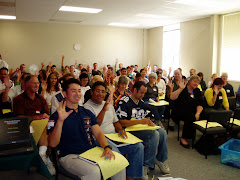
Pictures: Are of actual trainings I and Lena have delivered in order of appearance are:

Auckland - 14 day Neuro Semantic Trainers Training

Sweden - 3 day Self-leadership

Civil Aviation Trainers in the South Island of NZ - http://www.ignition.org.nz/

Sunday, August 16, 2009

The Covert Pessimist

Look for the silver lining inside every dark cloud, always look on the bright side, find something positive in every bad situation or say to yourself "...there are less fortunate people on the planet than me" and finally - "...always look on the bright side of life!"


I'm sure you've heard these statements or similar, once or twice before. Said by people who are promoting the importance of looking on the brighter side of life, when the chips are done or when life turns to custard. Some of us also know it by the question "Is the glass half full or half empty? (depends if your thirsty or not!) For those of us on the street we'd know the attitude in these examples as having a positive or negative attitude. For those involved in personality typing they're likely to call it optimism or pessimism. Either way it's all about how you interpret a situation you are faced with throughout your day.


I think there's plenty that's been said about optimism. You can read Dr. Martin Seligman's book called Learned Optimism and his other writings on the subject and optimism's well documented relationship with benefits for both our mental and physical wellness.


So... that's not what this article is about.


Entrenched Pessimissim
What I think that's needed (critical) is a more detailed understanding of how pessimism is so firmly entrenched in the very fabric of our being, that we do not recognise what we do and say, and is in fact, a constant pessimistic approach people have in general to the situations we face on a daily basis.


We can be so blinded by how we respond, to the point that we do not link our responses to having a pessimistic undertone. Usually because the mindset of pessimism is blended with other frames of mind like caring, protectiveness, achievement, love, clarity, trustworthiness etc.. and it is these frames that we are more conscious of and not the over arching driving frame of pessimism.


Let me explain by giving you 3 examples:


  • Your staff call while you are out of the office. You recognise the caller ID. You answer the phone by saying "Hi. What's wrong?" (You care about your business and the staff and assume that something is wrong when there has been no reference to there being a problem)

  • You have an upcoming exam that is very important for your advancement. You say to a friend " I'm so very nervous, I want to pass but it's going to be a tough exam." (You want to be successful in the upcoming exam yet frame the exam as being "tough")

  • You want to go fishing with the kids in the morning. You say to the kids "It had better be fine tomorrow or it'll be just terrible!" (You want the fishing trip to be a success and the kids to enjoy the day and predict that it will be terrible if the weather is not fine)


Hidden within each of these statements you'll find the fragments of a pessimistic attitude. This is all too common when you set your mind to listen for it. At times it may even appear on the surface to be an optimistic approach, but it is not. Have another read over the statements above. Some are more obvious than others - are they not?


Pessimism, as I am defining it, is found in more than the balatant and typical situations of whether something is either good or bad, easy or hard, or whether you can or can't do something. It permeates other responses like:


  • Regularly fault finding in what others say & do

  • Negatively escalating a situation (Mountain out of a mole-hill stuff)

  • Creating worst case scenarios that you are convinced are real

  • Being suspicious of other people, unnecessarily

  • Being fearful of situations that you've not experienced before

  • Creating future situations that have negative outcomes

  • Being overly protective of another person or project

  • Doubting what others say to you

  • Finding the exception to a situation that is positive or hopeful

  • Responding with an opposite response to the point of view being offered
The list I've made is not comprehensive. It's not meant to be. I hope that it gives you an idea of how to recognise a pessimistic response when you next make one or hear one from others.

I'm not saying that a person who positively explores a worst case scenario is being pessimistic. What I am saying is, it is a common pattern of response that you make when presented with a situation. Do you default to a worst case scenario and then escalate it too an even worse case scenario etc...?


Know It & Eliminate It
What I'm wanting you to do, is be more aware of how you respond.


  • Do you think of people as being untrustworthy, unreliable?

  • Do you think of people as being put to get you or see the worst in people?

  • Do you jump to conclusions about people that are actually unfounded but certain in your own mind.

  • Do you see the worst in people?

  • Do you find that you start more arguments with others, than they do with you?

  • Do you doubt what people say more often than not?

  • Do you feel insecure and inadequate?

Reading over these bulleted points, it could be easy for some readers to say "Hey, that's not a pessimistic attitude you've described there!" And, that is what I am talking about.


When I listen to a client while I am in coaching or training I often hear, what at first glance, appears not to be a pessimistic attitude. BUT - in my opinion, pessimism is found to be the over-arching theme that is present in what they are saying. Yes, they may say it's more about being safe, sensitive to who you can or can not trust and about not being gullible and getting sucked in by others etc... However - it is still NOT about having an optimistic view of the world and those around us!

I'm not saying that evaluating worst case scenarios is being pessimistic, quite the contrary. Positively analyse worst case scenario's and come up with solutions to them and implement them to mitigate the risks. That's an excellent approach. Burying yourself in worst case scenario's and escalating them to the tenth-degree as a negative, and in my mind, is not acceptable optimistic view.


There are plenty of reasons why we need to be aware of how our pessimistic attitude oozes out in all we do. From whether we can arrive at the office on time while being stuck in traffic or whether the person you love is telling the truth to you or not. Whether the fare the taxi driver is charging you is reasonable or the reason why your staff have not completed their time sheets on time is true. We are faced with situations daily and we have the choice whether we interpret each and every situation as being a positive or a negative.

How do you interpret frequent situations you are faced with? Even better, how do you interpret rare and infrequent situations? Do you implode or explode, as a direct result of what has happened? Do you find the possibility immediately or the impossibility?


A Lesson Worth Learning
This has to be one of life's simplest lessons. That you have 1 of 2 choices when faced with all situations. You have the choice when you listen, see and observe a situation to interpret it optimistically or pessimistically. You can always choose to find the good in what was said or the bad in what was said to you. In my opinion, no matter how you try to justify your negative attitude, it is still a negative attitude and therefore a pessimistic one.


Listen to how you respond - could you have chosen a more optimistic view at the time, no matter how bad it may have 1st appeared? Pessimism is more prevalent on our planet than optimism, is what I have found to be true. It seems to me that it is always easier to be pessimistic than it is to be optimistic about life's challenges. I'm not exactly sure why - perhaps it's the human condition at play, I'm not sure.
What I am sure about is, that we need to be more aware of how pessimism has seeped into our lives hidden in responses that we justify as being anything else other than - pessimism. Perhaps it's done to hold tentatively onto what we may think is an optimistic attitude, not comfortable to admit that we are in fact, more often pessimistic than we are optimistic!

Monday, August 10, 2009

Stress the Not So Silent Killer

I want to apologise for being a bit slow on writing this, my 1st blog for August. It's the 11th August and I haven't posted a blog to date, I'm sorry about that and plan on getting back up to speed straight away. So here goes...


What would you die for?

Your children? Your lover? Your Career? Your cat or dog? An attempt to break a world record? To save your house from burning down? Your car? To preserve your reputation?

What would you die for?

If your like most people, you wouldn't have likley, ever asked, such a question of yourself. Few people are ever put in a life or death situation and have had to decide whether they should do something which would risk their life.

The scenario I've been wanting you to consider is more the extreme end of deciding whether you live or die, yet there are daily pressures we put on ourselves, which over time, can indeed - kill us.

Stress Scale
A study of 5,000 people was undertaken to determine the level of stress people experience in 43 activities. The activities listed are ones we are faced with during the course of our lives. They retrospectively assesed their percieved level of stress of each of them and the top 14 activities I've listed below along with the score allocated to each of them. This list of stressors is known as the Holmes-Rahe Social Readjustment Rating Scale:

(They are prioritised as being the most stressful to the least stressful to deal with).
  1. Death of a Spouse - 100

  2. Divorce - 73

  3. Marital Separation - 65

  4. Imprisonment - 63

  5. Death of a Family Member - 63

  6. Personal Injury or Illness - 53

  7. Marriage - 50

  8. Fired from Your Job - 47

  9. Marital Reconciliation - 45

  10. Retirement - 45

  11. Change in Health of a Family Member - 44

  12. Pregnancy - 40

  13. Sexual Difficulties - 39

  14. Gain a New Family Member - 39

The researchers, Thomas Holmes and Richard Rahe suggest that a score of 300 or more is a strong indicator that your stress levels are too high and will have a negative impact on your health and well being. They also suggest, that a score of 150 or less means you have relatively low stress levels.

A closer look brings some interesting perspectives. How about Divorce which scored as number 2 and scored 73 points. Have you ever heard of people holding a "Happy Divorce Party"? That's right they are holding a party, celebrating that they just got divorced! How about including marital separation too? Another happy, amiable seperation! Then there are those that go to prison (#4 - 63 points) who are pleased they'll now have a roof over their head and 3 meals a day.


What I'm getting at here is stressors, are unique to each of us. What seriously stresses one person out i.e. under ground caving by 1 person vs claustrophobia experienced by another while caving. One persons joy can be anothers horror. Stress is as individual as you are.

We've all observed people getting seriously stressed out over something and stood wondering how the hell does that small thing cause so much stress! (or am I the only one who has seen this happen?). When this happens, you'll find often that the stressed person is quite vocal about what it is that stresses them out - thus the title: Stress, the NOT so silent killer.

I'm sure I'm not the only one that has worried themself sick at some stage in their life, over something. I've found myself in the past, staying awake late at night, unable to get to sleep and forgotten what I was doing, while supposedly at work during the day. My unique stressors occuping all my thoughts and draining me emotionally as each dragging minute passes by. Loss of focus, energy and at times, losing the will to go on with life. This is no joke and sadly many can be so stressed that they take their own lives or the lives of others (not good!).

I read recently that 3 people here in NZ had committed suicide because their homes had been completely ruined due to damp rot. The house had been constructed with non treated timber and as a result was rotten and unable to be repaired, so the house was worthless! I didn't see loss of your home scoring high in the Holmes-Rahe scale, yet people have taken their lives due to the complete loss of the value of their home.


Useful Stress Tips
Knowing that stress is a unique experience it'll be a good thing for you to know what you can do to minimise it. In my coaching I often come face to face with clients who are emotionally drained and stressed due to either a clash with work collegues or at home in their personal lives. It definitely can be like unravelling a badly tangled fishing line, yet well worth it in the long run.

Here are 7 effective strategies (there are many more) you can use to lower the intensity of those things that are stressing you out:


ONE:
Write a full description (leave nothing out) of what it is exactly that is causing the stress. Include your own attitude towards the stressors as well as all of the external factors. Ask yourself "Is this really as bad as it seemed, now that I have written it out?" It's likley that you now see it for what it is (pseudo stressor) and are better able to deal with it. If so, deal with and move onto more difficult things than what was previously stressing you out. We too easily make mountains out of mole hills!


TWO:
Identify if the stress is either in the past or future. If the stress experience is in the past understand that you can not turn the clock back and change what has happened. What is done - is done! Decide what you can do today about how you will think differently about what has happened to you in the past. What happened can not change - how you think about it can.

How would you like to think about things that empowers you while also allowing you to positively learn from what happened? Should it ever happen again in the near future, how will you deal with it differently? Celebrate your learnings and focus on the present and plan for the future.

If the stressor is in the future. What the hell are you doing? It hasn't happened and you want it to be awful and that is why you are thinking terribly, to the degree that you are stressed the hell-out about something that hasn't even happened and is highly likely - not to!

Decide what the problem is that you are faced with in the near future and make an effective plan to minimise the problems that you forsee in the future. Focus on what you can do and mentally rehearse a positive outcome. That approach is way better than traumatising yourself unduly and then focus on what you need to do in the present to make the future materialise the way you want it.


THREE:
Rate the level of stress that you are currently experiencing from 1-100 (1 being very low). Decide, by writing a list, what must be done to cut it by 50%. Prioritise the list and focus on the 1 thing that will make the biggest difference immediately. Ensure that what you need to do to lower it is within your own personal power and is not reliant on other people changing 1st. Make an immediate action plan on how and when you will undertake and complete the required actions that will significantly lower the stress.


FOUR:
Make a list of activities that you can do that make you happy. They are to be activities that do not include spending money, alcohol, drugs or another person. Once you have the list (preferably 12 or more activities) work at creating a situation where you are able to string together 3 or 4 of these activities back to back.


FIVE:
Write a daily list of what you are grateful for. This is an attitude of gratitude journalling. Do it daily and do it 2-3 times per day. If you find it hard initialy, that's ok. DO it any way and write down the smallest of things that you are grateful for. Become mindful of being ever more grateful as the days and weeks progress. At the end of each week re-read what you had written for that week and entertain the idea of how good it is to be greatful for both small and big things. The attitude you gain from doiung this exercise will make dealing with any stress, easier.


SIX:
Imagine that you were the creator of all the Universe. Journey in your mind out into the universe and look back on our beautiful planet, from a distance. Think of how long the planet has been delicately balanced in space for millions of years. Think also of the time that it has been here and how long you have been living on planet earth. Imagine the many years you have yet to live and the many thiings that you have yet to do. The things you know you want to do and the numerous things you'll do that you don't even know now! When you think of the length of time that has been and has yet to be. How small does the stress in your life take up when you compare it to the larger time line of the planet and you life so far? Knowing that... what do you need to do to lower the stress in your life? Make a list. Go and action that list immediately.


SEVEN:
Spend time with those people who care for you deeply. Eat, walk, talk and share with them. Remember how loved you are and those who love you now and those have loved you in the past. Draw strength from them. How would they want you to respond to the stress in your life? What advice would they give you knowing they have only empowering and uplifting advice for you? Make a list and action that now.


Well - coaches, trainers, manager, friends... there you go. You now have 7 strategies on how to minimise your stress levels or 7 techniwues you can use in coaching a client. Remember, if you have stress in your life you'll continue to have stress if you do not do something about eliminating it or minimising it, so do something about it immediately.


Life is too short to waste time on unnecessary stress.